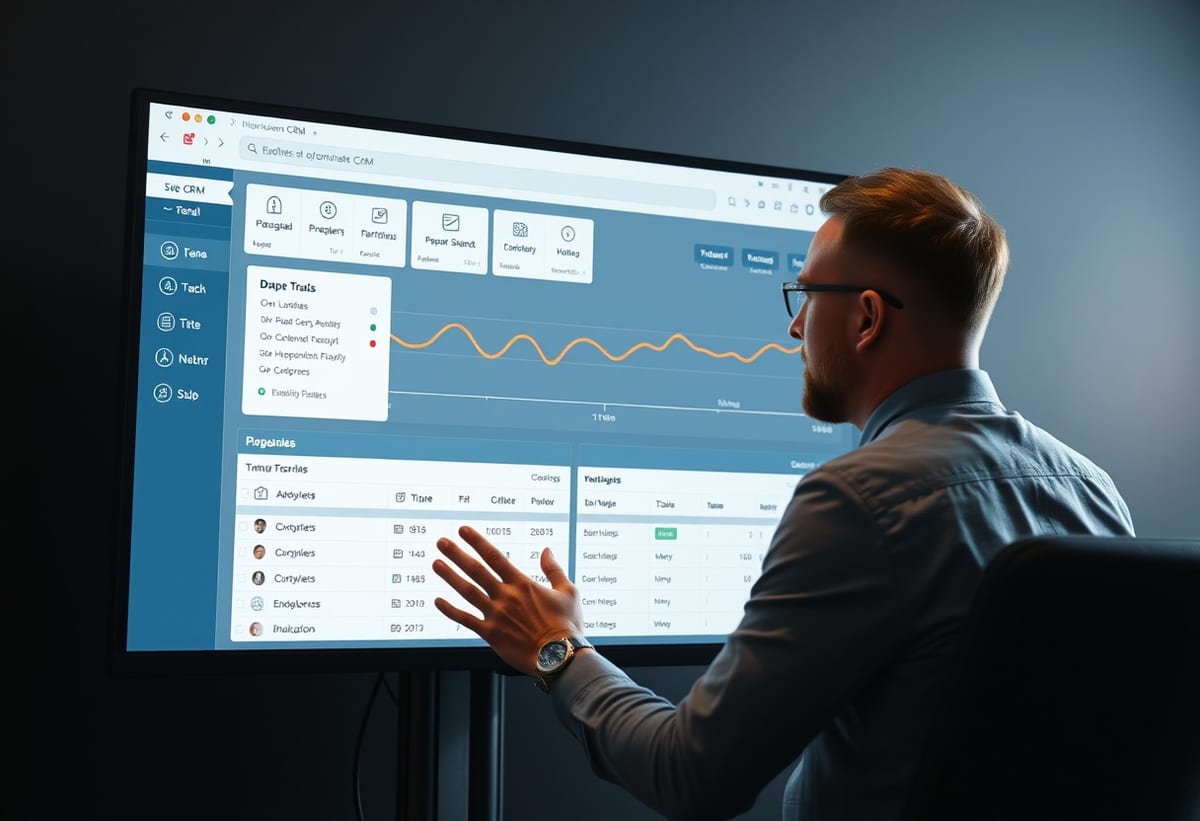
Custom CRM development gives UK SMEs a customer relationship system built around their actual sales process rather than forcing their team to work the way a generic product expects. Off-the-shelf CRMs like HubSpot, Salesforce, and Zoho are powerful, but they serve thousands of businesses with a one-size-fits-all model. When your sales pipeline, your customer data, and your reporting needs are specific to your industry and your way of working, a custom CRM eliminates the compromises, the unused features, and the per-seat licensing costs that add up year after year.
What Is a Custom CRM?
A custom CRM is a customer relationship management system built specifically for your business. Unlike off-the-shelf CRMs that try to serve every industry with a generic feature set, a bespoke CRM is designed around your exact sales process, your data structures, and your reporting requirements.
The building blocks are the same as any modern CRM: contact management, pipeline tracking, activity logging, communication history, and reporting. What is different is how those pieces are assembled. A custom CRM captures the fields that matter to your business, enforces the workflow your team actually follows, and presents the information in a way that is immediately useful rather than requiring weeks of configuration and customisation.
Think of it as the difference between buying a suit off the rack and having one tailored. The off-the-rack version might fit reasonably well if you are close to the average size. But if your business is not average, if your sales process has steps that generic CRMs do not account for, the tailored version fits perfectly from day one.
When Should a UK SME Consider Custom CRM Development?
Most businesses do not start looking for a custom CRM. They start with an off-the-shelf product, configure it as best they can, and live with the gaps. Here are the signs that a custom CRM might be the right move.
Your Team Has Stopped Using the CRM Properly
The most common symptom of a poor CRM fit is declining adoption. If your sales team is logging calls in spreadsheets, keeping notes in notebooks, or only updating the CRM when someone insists, the CRM is working against them rather than for them. This happens when the system is too complex, requires too many clicks, or does not capture the information your team actually needs.
A custom CRM is built around the way your team works, not the other way round. When the system matches the workflow, adoption is natural because the CRM makes the job easier rather than adding administrative burden.
You Are Paying for Features You Never Use
Off-the-shelf CRMs bundle features to appeal to the widest possible audience. A typical SME uses perhaps 20% of the available functionality. The other 80% is noise that clutters the interface, confuses users, and inflates your monthly bill. According to research by Blissfully, the average SME spends over £5,000 per year on SaaS tools they barely use, and CRM licences are a significant contributor.
A custom CRM includes only what you need. No unused modules, no per-seat pricing for features nobody touches, no annual price hikes for functionality you never asked for.
Your Sales Process Does Not Fit the CRM’s Model
Generic CRMs assume a linear sales pipeline: lead, qualified, proposal, closed. If your sales process is more nuanced, with parallel tracks, conditional stages, or industry-specific milestones, you end up bending your process to fit the software. A custom CRM models your actual pipeline, with the stages, gates, and logic that reflect how your business really sells.
You Need Deep Integration With Other Systems
If your CRM needs to talk to your accounting system, your inventory database, your job management tool, or your industry-specific software, off-the-shelf CRMs often require expensive third-party integration tools or manual data entry. A custom CRM can be built with native integrations from the start. Our system integration services UK handle exactly this kind of connectivity, ensuring your CRM is not an island but a connected part of your business infrastructure.
How Much Does Custom CRM Development Cost in the UK?
This is the question every business owner asks first, and the honest answer is that it depends on scope. But let me give you a framework for thinking about it.
A straightforward custom CRM for a small business, covering contact management, pipeline tracking, activity logging, and basic reporting, typically costs between £15,000 and £30,000 to build. A more complex system with custom integrations, advanced reporting, role-based permissions, and mobile access might range from £30,000 to £75,000.
The comparison that matters is not the build cost against zero. It is the build cost against the lifetime cost of your current CRM subscriptions. If you are paying £40 per user per month for 15 users, that is £7,200 per year, rising annually. Over five years, that is £36,000 plus whatever price increases the vendor applies. A custom CRM has an upfront cost but negligible ongoing licensing fees, and you own the system outright.
For a detailed breakdown of this comparison, our guide on custom software vs SaaS total cost of ownership walks through the maths step by step.
What Are the Advantages of a Bespoke CRM Over Off-the-Shelf?
Exact Fit, No Compromise
The primary advantage is fit. A bespoke CRM captures your data model, your workflow, and your reporting needs exactly. No workarounds, no missing fields, no generic dashboards that require filtering and drilling to get to the information you actually want.
Lower Lifetime Cost
After the initial build, a custom CRM costs a fraction of what you would pay in subscription fees. Hosting is typically £50 to £200 per month depending on usage. There are no per-seat licences, so adding users does not increase your costs. Over three to five years, the savings are substantial.
You Own It
With an off-the-shelf CRM, you are renting. The vendor controls the pricing, the roadmap, the features, and the data. If they raise prices, change the interface, or discontinue a feature you depend on, you have limited recourse. With a custom CRM, you own the code, the data, and the roadmap. Nobody can turn it off or change it without your agreement.
No Vendor Lock-In
SaaS CRMs create dependency. Your data lives in their system, exported in their format, on their schedule. A custom CRM stores your data in a database you control, accessible through standards-based APIs, exportable in any format you choose. If you ever want to move on, you can.
What Are the Risks and How Do You Mitigate Them?
Custom development is not without risk. Here are the common ones and how to manage them.
Scope Creep
The biggest risk in any custom software project is scope creep, where the project grows beyond its original boundaries. Mitigation is straightforward: start with a clear specification, build in phases, and prioritise the core features first. A phased approach lets you launch a working system quickly and add features based on real usage rather than speculation.
Building the Wrong Thing
If the CRM does not match how your team works, it will not get used. The mitigation is to involve your team in the design process from the beginning. We start every CRM project by shadowing the sales team, understanding their daily workflow, and designing the system around their actual needs rather than an idealised version of the process.
Maintenance and Support
A custom CRM needs ongoing maintenance: security updates, dependency upgrades, and occasional feature additions. This is where the founder-led plus specialist network model works well. You get a dedicated point of contact who understands your system and can pull in specialists as needed, without the overhead of a permanent in-house team. Learn more about this approach in our bespoke CRM development services.
How Long Does Custom CRM Development Take?
For a typical SME CRM, the timeline looks like this:
- Discovery and specification: 1 to 2 weeks
- Design and prototyping: 1 to 2 weeks
- Core development: 4 to 8 weeks
- Testing and refinement: 2 to 3 weeks
- Launch and onboarding: 1 week
Total elapsed time is usually 8 to 16 weeks for a first release. The key is to launch a working version early and iterate based on real usage. This is the same AI-accelerated approach we describe in our guide on how AI accelerates software development, which can compress these timelines significantly.
Should You Build or Buy a CRM?
The build vs buy decision for a CRM comes down to three factors: how standard your sales process is, how much you are spending on subscriptions, and how important integration with your other systems is.
If your sales process is straightforward and you are happy with a generic CRM, buy. If your process is specific, your subscription costs are high, and you need deep integration with other systems, building makes more sense. Our build vs buy guide for UK SMEs covers this decision in detail.
If you operate in a specific sector, we have guidance tailored to your needs. For example, marketing agencies managing client relationships can benefit from our software for marketing agencies insights.
Recommended Reading
- Build vs Buy Software UK SME - A structured framework for deciding whether to build or buy software for your business.
- Custom Software vs SaaS Total Cost of Ownership - The real maths behind subscription sprawl versus owning your own software.
- System Integration for UK SMEs - How to connect your CRM with accounting, inventory, and other business systems.
Next Steps
If you are spending too much on CRM licences, your team is not using the system properly, or your sales process does not fit a generic CRM, a custom build might be the answer. Explore our bespoke CRM development services to see what a tailored system could look like for your business, or book a free discovery call to discuss your specific needs. If you work in a sector with specific CRM requirements, our industry-specific software solutions cover everything from accountants to logistics companies.