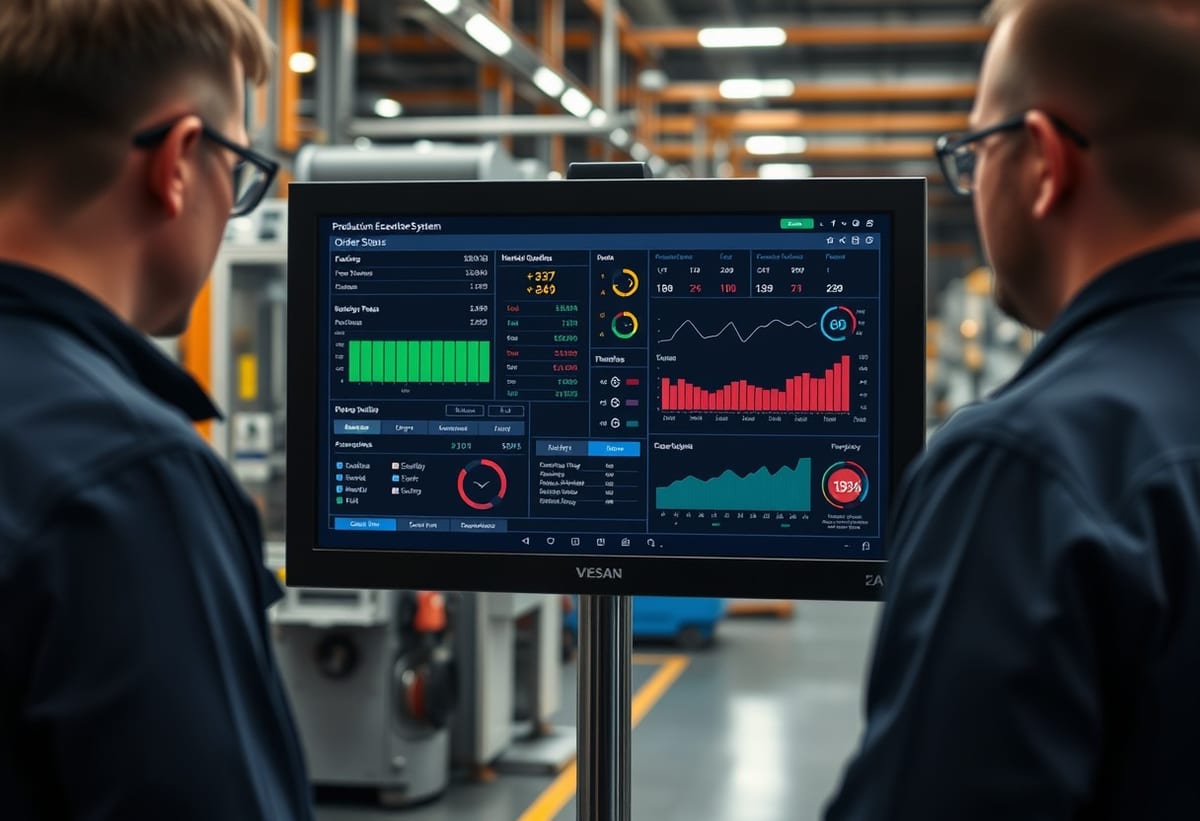
Custom software for UK manufacturing gives small and medium-sized producers a Manufacturing Execution System (MES) and production tracking tools built around their specific processes rather than forcing their operation to fit a generic template. UK manufacturing is undergoing a resurgence, with ONS data showing manufacturing output contributing £224 billion to the economy. Yet many SME manufacturers still rely on paper-based tracking, spreadsheets, and legacy systems that cannot provide the real-time visibility modern production demands.
What Is a Manufacturing Execution System?
A Manufacturing Execution System (MES) is software that manages and monitors work in progress on the factory floor. It tracks every production order from raw materials to finished goods, recording who did what, when, and with what results. An MES gives you real-time visibility into production status, quality metrics, and machine performance.
For large manufacturers, commercial MES systems are available from vendors like SAP and Siemens. These systems are powerful but expensive, complex to implement, and designed for large-scale operations. For UK SME manufacturers, a custom MES built around your specific production process is more practical, more affordable, and more effective.
Why Do UK SME Manufacturers Need Custom MES Software?
Generic MES Does Not Fit SME Production
Commercial MES systems are designed for large, complex operations with standardised processes. UK SME manufacturers typically have more flexible, more varied operations. A small manufacturer might produce 50 different products on the same line, with different routing, quality checks, and packaging for each. Generic MES systems struggle with this variety. A custom MES is built around your actual production process, with your routing, your quality checks, and your reporting.
Paper and Spreadsheets Are Costing You Money
If your production tracking involves paper route cards, manual data entry, and spreadsheet-based reporting, you are losing money. Paper-based tracking means delayed information, errors in transcription, and no real-time visibility. According to Make UK, the manufacturers’ organisation, UK manufacturers lose an average of 8% of productive time to inefficient production tracking and reporting. A custom MES eliminates paper, provides real-time data, and gives your team accurate, timely information to make decisions.
You Cannot Get Real-Time Production Visibility
When production data is recorded on paper and entered into a system at the end of each day or week, you cannot see what is happening on the floor in real time. You cannot identify bottlenecks as they occur, you cannot adjust schedules based on actual progress, and you cannot spot quality issues before they become expensive. A custom MES provides live dashboards showing production status, machine utilisation, and quality metrics.
Your ERP Does Not Know What Is Happening on the Floor
Most UK SME manufacturers have an ERP system that manages orders, inventory, and invoicing. But the ERP typically does not know what is happening on the factory floor. There is a gap between the order being released and the finished goods being received. A custom MES fills this gap, feeding real-time production data back to the ERP and closing the information loop.
What Can a Custom MES and Production Tracking System Do?
Real-Time Production Tracking
Track every production order through each stage of your process, from material issue to quality inspection to finished goods. Your team sees the status of every order, what is in progress, what is queued, and what is completed.
Machine Integration and OEE Monitoring
Connect to machines on the floor to capture run time, downtime, and performance data automatically. Calculate Overall Equipment Effectiveness (OEE) in real time, identifying bottlenecks and underperforming equipment. No more manual OEE calculations from paper records.
Quality Management
Record quality inspections at each production stage, flag non-conformances, and trigger corrective actions. Build your specific quality checks into the system so that nothing can bypass inspection.
Material Traceability
Track every batch of material through every product it is used in. When a quality issue is identified, trace it back to the raw material batch in seconds rather than days of searching paper records. For food and pharmaceutical manufacturers, this traceability is a regulatory requirement. For all manufacturers, it is a competitive advantage.
Production Scheduling and Capacity Planning
Schedule production based on machine capacity, material availability, and order priorities. See conflicts before they happen and adjust schedules dynamically. Our workflow automation services handle this kind of dynamic scheduling.
Custom Reporting and Analytics
Dashboards and reports built around the metrics that matter to your business: on-time delivery rate, scrap rate, machine utilisation, labour efficiency. No more building reports manually in spreadsheets.
How Much Does Custom MES Software Cost?
Basic Production Tracking
Digital production tracking replacing paper route cards, with order status, basic quality checks, and simple reporting. Typically £20,000 to £40,000.
Integrated MES
A full MES with machine integration, OEE monitoring, quality management, and material traceability. Typically £40,000 to £90,000.
Complete Manufacturing Platform
A full system including MES, production scheduling, ERP integration, and advanced analytics. Typically £70,000 to £150,000.
The comparison is against the cost of production inefficiency. If your manufacturing business loses 8% of productive time to poor tracking, on a turnover of £2 million that is £160,000 per year. A custom MES that recovers even half of that lost time pays for itself within the first year.
How Long Does MES Development Take?
- Process mapping and specification: 2 to 4 weeks
- System design and architecture: 2 to 3 weeks
- Core development: 10 to 20 weeks
- Machine integration and testing: 4 to 8 weeks
- Pilot deployment and refinement: 3 to 6 weeks
Total elapsed time is typically 21 to 41 weeks. Manufacturing systems are complex, and machine integration in particular can be time-consuming. The approach is to start with digital production tracking, prove the value, and then add machine integration and advanced features in phases. Our software for manufacturing page covers this phased approach in detail.
How Do You Integrate MES With Existing Systems?
ERP Integration
The most important integration is with your ERP. Production orders flow from the ERP to the MES, and production status, material usage, and finished goods flow back. This integration can use APIs if your ERP supports them, or file-based exchange if it does not. Our custom API development services handle ERP integration for all major systems.
Machine Integration
Modern machines often support protocols like OPC UA or MTConnect for data collection. Older machines may need sensors or PLC integration. The approach depends on the age and type of your equipment.
Quality System Integration
If you have an existing quality management system, the MES should feed inspection results and non-conformance data into it. This avoids duplicate data entry and ensures quality records are complete.
Recommended Reading
- System Integration for UK SMEs - Connecting MES with ERP, quality systems, and other business software.
- Legacy Software Modernisation: A UK SME Guide - When your current production tracking system needs replacement.
- Custom API Development: Connecting Your Business Systems - The APIs that connect MES with ERP and machine data.
Next Steps
If your manufacturing operation is being held back by paper-based tracking, spreadsheet reporting, or a gap between your ERP and your factory floor, custom MES software is the answer. Explore our software for manufacturing solutions to understand what is possible, or book a free discovery call to discuss your specific production process. Our bespoke software development services provide the full range of custom software capabilities your manufacturing business may need.